Bookkeeping QuickBooks Cleanup Help For Texas owners
Leave the mug shop file open on your side of the call. Dallas is where the practice works, the franchise report and the sales tax return get named from that screen, and the password field stays empty.
The practice is in Dallas
Steven Palmieri works from Dallas. The invented mug shop on the other pages of this site can be dropped into any part of Texas and the call still happens on video. A kiln in the Hill Country, a counter along the Gulf, a yard up in the Panhandle, or a company outside Dallas and Fort Worth keeps its own floor.
Point the camera at the title bar, say the oldest month still visible, and leave the password field blank the way the national pages already ask. We have not stood in that shop, and we will not talk about your block as if the call were a visit.
When the shop is in Texas and not in Dallas, we are all Texans on that call. The bank still has to agree with the month before a return uses it. The login stays in your hands. Miles do not shrink the report, and sharing Dallas with the practice does not enlarge it.
The rest of this site speaks to an owner in any state and keeps doing that. Only this page puts the Texas filings next to the file you already have open. If the company was never organized for Texas and is not doing business there, close this page and stay with the report on the screen.
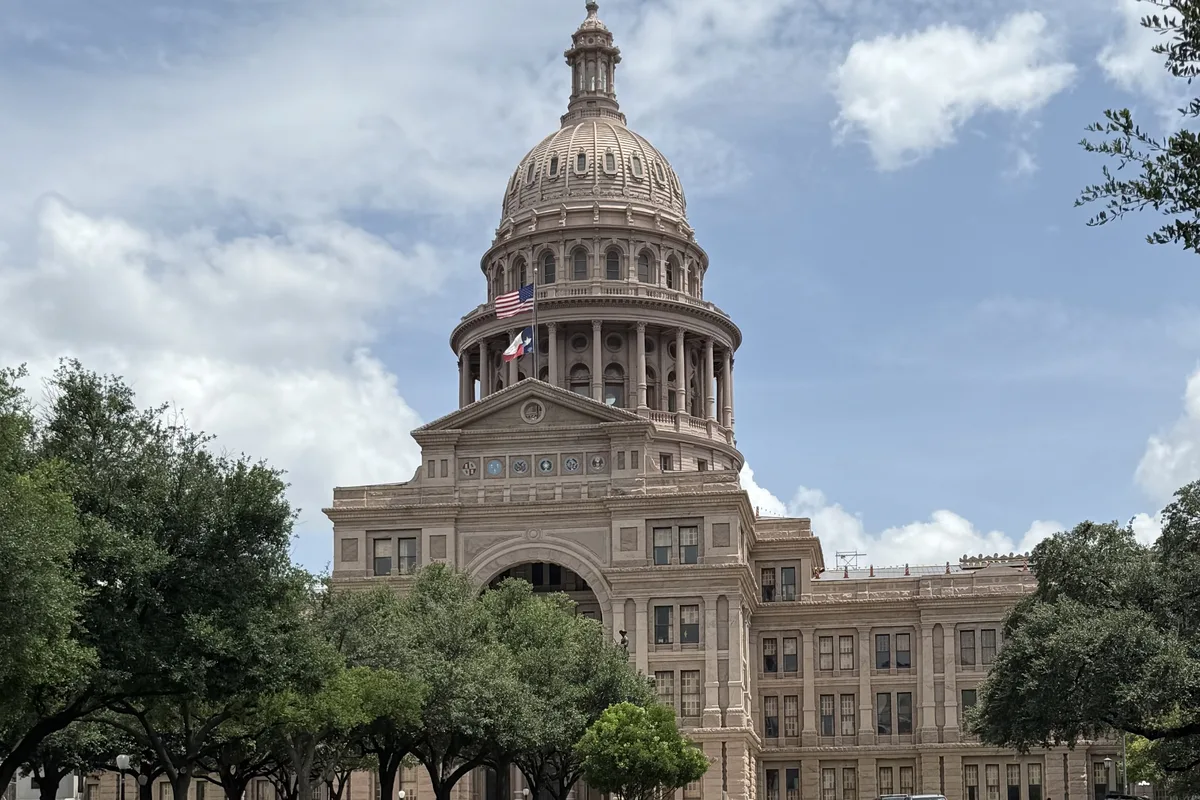
Farragutful photographed the Texas State Capitol in Austin and released that frame on Wikimedia Commons under CC BY-SA 4.0. The dome is the state's building. It is not a room this practice uses, and we do not meet anyone under it.
Two reports the open file can already show
A Comptroller envelope often arrives while the mug shop's profit and loss is the only thing on the glass. The letter wants a number. The bank has not agreed with the month yet. Start by reading the title bar out loud, then ask whether that one report can answer the letter.
Two state reports can hide in a file like the mug shop's. The yearly franchise report is the charge for the privilege of keeping the company alive in Texas. The sales tax return follows the feed more closely, because a deposit and a taxable mug sale are not the same line.
We stay inside the report you can already see. A profit and loss that worried you is where we ask whether its revenue is the revenue the franchise report will borrow. A bank screen that worried you is where we ask whether that month's sales tax return is still sitting open.
Neither report is reached by handing over the login. You remain signed in. If a form has to travel, you export it yourself, or you leave it up while we look together. Collecting the password in the same note as a Comptroller letter is a mess we will not make.
Who the privilege report is for
The Comptroller calls the franchise tax a privilege tax. It reaches each taxable entity formed in Texas, and each one doing business there. When the mug shop's open report has to say whether this company files, we open Publication 98-806 and follow it. A shorter homemade list does not get pinned beside the title bar.
For the mug shop, Publication 98-806's filer list is the thing to read, and it runs through joint ventures, trusts, professional associations, partnerships, banks, S corporations, series companies, a one member limited liability company, and corporations. Someone selling mugs under their own name, who never formed a company, generally never meets this privilege report. A sole proprietorship that never became a limited liability company is generally off it too. A general partnership made up only of natural persons stays off the report as well, right up until it is registered as a limited liability partnership.
Publication 98-806 sends the doing business question to Rule 3.586. We hold that rule up against the facts you can show on the screen. A test we wrote ourselves does not get typed under the open report.
Put 15 May on the mug shop calendar as the franchise report's date. Should 15 May land on a Saturday, a Sunday, or a holiday, the mug shop files on the following business day. Look that moved day up on the Comptroller extensions page in the year of the filing, because a Monday remembered from last May is not this May. A Monday carried over from last May is how the real day gets missed.
When the month on the glass can be tied out before that date, the figures the report wants can be read from the file. If that month cannot be tied before then, mark the report open on the screen and name who will file from the books in the shape they have now. A federal return and a Texas return both wait for a month the bank can support. A Comptroller letter does not loosen that wait.
The short report when the tax itself is zero
On the 2026 row and the 2027 row, yearly revenue at or under 2,650,000 dollars means the franchise tax report itself stays off the calendar. The short information report stays on the calendar as its own sheet unless the Comptroller has already placed the mug shop's company on a skip list.
One of the two short reports is Form 05-102, called the public information report, and the other is Form 05-167, called the ownership information report. The 2024 row and the 2025 row used 2,470,000 dollars as their line. That older line stays on those years. It does not get copied into a 2026 talk about the file on the glass.
Skip that short report and the mug shop's company can forfeit the right to keep operating. The forfeiture warning the Comptroller prints names Tax Code sections 171.251 and 171.2515, then 171.252 and 171.255. Forfeiture can take away the right to sue or to defend in a Texas court, and it can place certain debts on officers, directors, partners, members, or owners. Financial institutions are kept outside that forfeiture result by sections 171.259 and 171.260.
When the mug shop is a Texas corporation, or a limited liability company, or a limited partnership, or a professional association, or a financial institution, the short report it signs is Form 05-102. The person who signs has to be an officer, a director, or someone else the company already authorized. Other taxable entities organized in Texas, or with nexus here, use Form 05-167, and the ownership information on that form stays confidential.
Inside a combined group, a member organized in Texas and a member with nexus each still file a short report on the franchise date, and a year under the no tax due line does not excuse that member. The instructions already waive both short forms for an exempt entity, for an entity with no Texas organization and no Texas nexus, for a passive entity, and for a qualifying new veteran owned business through the first five years. The open file should not add a filing the instructions already waive.
Change an officer after the report is in, and the next annual report is soon enough, unless an error or a genuine need calls for an amended report. A replacement registered agent is recorded with the Secretary of State. Form 05-102 does not carry that change, and Form 05-167 does not carry it either. If the open screen never shows the short report, a year with zero franchise tax can still become the year the mug shop loses its standing, even while a spring month is only half matched to the bank.
Four ways the margin can be built
Once tax is actually owed, the figure is margin, unless the mug shop qualifies for the EZ computation and chooses it. Say the path out loud from the title bar before anyone treats the revenue line as finished.
Publication 98-806 lays out four paths. Path one, for the mugs on the screen, keeps 70 percent of total revenue and sets the rest aside. One takes off the cost of the goods. One takes off compensation. One subtracts 1,000,000 dollars, a subtraction the statute has allowed since the first day of 2014. Start from the federal revenue amounts already on the profit and loss, then remove what Tax Code section 171.1011 excludes, and what remains is total revenue for this report. A second, prettier revenue does not get typed beside the revenue the month already made true.
Clay, glaze, and any real property sold in the ordinary course carry a goods cost, and on that path the cost is generally the outlay to acquire those things or to produce them. A counter that sells only services, rather than clay and glaze, often has none of that goods cost, aside from the industry exceptions written in section 171.1012. For the people throwing clay and the people running the till, the compensation path counts W-2 wages and cash paid to officers, directors, owners, partners, and employees, counts net distributive income paid to natural persons inside a cap for each person, and counts benefits the instructions allow, workers compensation and health care and retirement among them.
The same path leaves out 1099 labor and leaves out the payroll taxes the employer pays. On the national pages we already ask whether a deposit is a mug sale or the owner's own money. A 1099 payment does not turn into compensation just because a Texas form would look better with a larger subtraction.
Once a path is spoken from the title bar, Texas is given only the slice of margin that gross receipts place in Texas. A combined group uses one method for the whole group. On the mug shop's 2026 row and its 2027 row, read 0.375 percent when the trade is retail or wholesale, read 0.75 percent for every other trade, and read a compensation cap of 480,000 dollars for each person. Park 450,000 dollars on the 2024 row and the 2025 row. That older cap does not migrate forward, and the newer cap does not migrate back.
If annualized total revenue is 20 million dollars or less, the mug shop may pick the EZ computation and the rate on that choice is 0.331 percent. Choosing EZ on the mug shop return sets the margin deductions aside, so they cannot be used on that same return. Above the no tax due line, the long form remains when EZ is not the choice, and it remains when the company wants a margin deduction. None of those rates is usable until the month on the glass has revenue the bank will stand behind.
A report printed for a financial statement is a different product from this franchise report. This page stays with the franchise report and with the books that feed it. The open screen does not get dressed up as another kind of product.
Late, extended, or the last report
A report that arrives after its day costs 50 dollars. Tax that shows up inside the first 30 days costs 5 percent more. Tax that shows up later than that costs 10 percent more. Unpaid franchise tax begins to draw interest on day 61, and not before. That interest percent is left on the Comptroller interest page. The open screen does not repeat it.
Have the payment in their hands by the original due date, or have a Comptroller form there by that same date, and the mug shop's extra time has started. The amount we would want to see is either the whole of last year's tax or 90 percent of the tax this report will finally show. The first annual report cannot use the whole of the prior year's tax when the company only became subject to the tax during that prior year.
While the state has not placed the mug shop on electronic funds transfer, Webfile or Form 05-164 is how the extra time travels, and it travels out to 15 November. Electronic funds transfer becomes the mug shop's way to pay after the previous state fiscal year shows 10,000 dollars or more of this tax already paid. The first extra date is then 15 August, and a second stretch of extra time can run to 15 November.
Reach 500,000 dollars or more and the extra time is asked for by a timely TEXNET payment under code 13080, without also sending Form 05-164. Whether that payment beat the clock is read on the live extensions page. The clock is not copied onto this screen.
If Texas nexus is ending while the open file is being put in order, the final franchise report is due within 60 days of that ending. Another 45 days exists only when the final report's payment rules are already met. Closing the company, or ending the Texas connection, stays your decision. The final report and the Secretary of State certificate of account status belong in that closing, in the order the Comptroller close or reinstate page actually prints.
A research and development credit changed for filings dated 1 January 2026 or later. Follow the franchise home page for the research credit change, rather than a note saved from an older year. If the mug shop's report will claim the credit, we follow that page for the year in front of us rather than a memory of the old rule.
Sales tax on the same open file
Sales tax is the other report that can sit in the mug shop's open file. It belongs with the bank lines from the oldest month still unmatched, not in a folder that stays shut until a letter sounds angry.
Of the price of one mug, 6.25 percent is the state's own sales tax. Local tax may be added by a city, by a county, or by a transit district, and that local piece is capped at 2 percent. Put the two pieces together and a buyer of one mug still stops at 8.25 percent. No city's own rate is printed here. The address of that sale is looked up on the Comptroller rate locator the day the mug is sold.
The letter that follows a new permit tells the mug shop whether its sales tax return is monthly or whether it is quarterly. Keep that letter with the statements. A monthly return comes due on the 20th of the next month, and the Comptroller's own example places the April report on 20 May. If the 20th is a weekend or a holiday, the day moves to the next working day.
April, July, October, and January are the four months a quarterly sales tax filer meets the Comptroller. A yearly sales tax schedule reports the year that just ended, and the day for that report is 20 January. If the month on the glass will not be tied in time, say the sales tax return is still open, the same way you would say the franchise report is still open.
Reporting and paying on time lets the seller keep half of one percent of the tax. Paying ahead lets the seller keep that half of one percent and another 1.25 percent. A sales tax report that misses its day costs 50 dollars, then 5 percent of the tax if the tax arrives inside 30 days and 10 percent if it arrives after that. Interest starts on day 61. Sales tax interest keeps its percent on the Comptroller interest page, and the percent is not written on this screen.
A buyer who will truly resell the mug hands over Form 01-339. Typing a permit number into a message does not replace that form. The filled in form is what the seller keeps, and the keep is four years, the same stretch a seller keeps for gross receipts. If the buyer later uses the mug inside the shop, tax is due on that use and it lands on the taxable purchases line. A certificate offered for something the business does not resell is a certificate to question. The Comptroller's picture of that mistake is a service station certificate offered for a sofa.
Mugs a marketplace already collected tax on are still Texas sales. They go into total Texas sales, and they come back out of taxable sales when the marketplace agreed, in terms the seller already accepted, to collect. Both sides can be audited, so the records stay in the file. That agreement does not need an extra form.
A remote seller whose Texas revenue over the prior twelve months stays under 500,000 dollars is inside the safe harbor and does not have to get a permit or collect use tax. Sales made through a marketplace count toward that 500,000 dollars even when the marketplace is the one collecting. The Comptroller's illustration puts 300,000 dollars through the seller's own site and 300,000 dollars through marketplaces. Together those two piles cross the line, so the seller collects on the site sales and the marketplaces collect on theirs.
A remote seller who sells only through a marketplace, and who accepted that collection agreement in good faith, can skip the permit and must still keep the records. A person who lives in Texas and sells only through a marketplace still needs the permit, because living in Texas is a physical presence. Inventory that only pauses inside a marketplace warehouse in Texas does not by itself force a permit while the seller is under the harbor and the provider agreed to collect. Once the harbor is crossed, the seller gets the permit and collects. A taxable entity that stores inventory that way still has the franchise report to face.
Only a remote seller uses Form 01-799, and that form is where the single local use tax rate is carried. The FAQ has put that extra local piece at 1.75 percent, and the Comptroller recomputes it, so the FAQ open on the day you file is the one that wins. A marketplace provider is outside that single local rate and does not get to apply it. A large sales tax payment sent by TEXNET follows a clock printed on the Comptroller page, and a letter arrives when a business crosses into electronic payment. We read that letter with you from the open file. The clock is not guessed.
What you say while you stay logged in
On the call, read the title bar, name the oldest month still on the glass, and hold up the Comptroller letter if one is already in the stack. We will say whether that month can carry both the franchise report and the sales tax months, or whether one of them has to stay visibly open.
A fee is written on a scope after that conversation, not on this page. Should the open months be few, and should the bank already agree with them, we will say the books work is unnecessary. The Texas reports can still come due on their own calendar. We will not invent a project so the call looks busy.
Leave the call holding a report name, a month, and a plain answer about the franchise report and the sales tax return. A later disagreement goes back to that answer. It does not go back to a memory of the call. The password never becomes part of the answer.
April, June, September, and January are when the federal estimates fall, and any one of them can land beside 15 May or beside the 20th. They share a calendar with 15 May and with the 20th. If one of them is close, say so while the file is still open. This page cannot see your year. Hearing the collision from you is better than finding it after a line has already changed.
Name the report on the screen.
Name the report in the title bar, and say whether a Comptroller letter is already in the stack. Leave the password out.
You will be talking to the Steven Palmieri practice.